
Forge Reads: The Comfort Crisis
A Forge Reads reflection on The Comfort Crisis by Michael Easter, exploring discomfort, resilience, and why leaders lose sharpness when life becomes too easy.
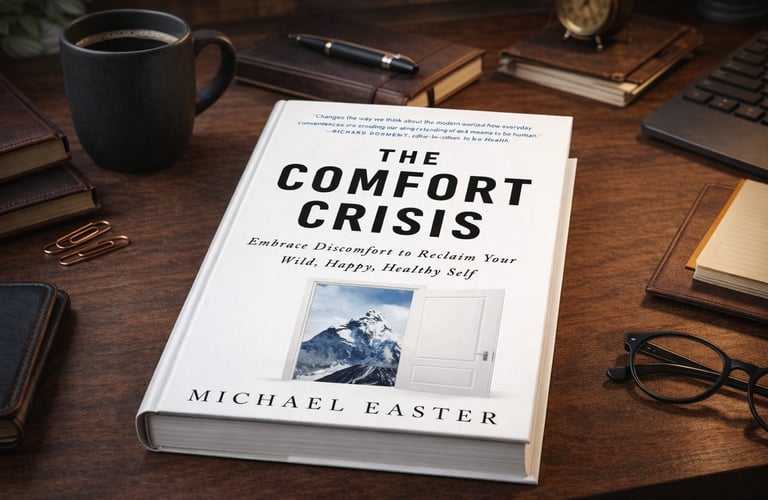
Forge Reads: The Comfort Crisis
Leadership today often happens in remarkably comfortable conditions. Tools remove friction. Systems absorb pressure. Distance separates decisions from consequences. Over time, that comfort becomes normal. Invisible, even.
The Comfort Crisis forces you to notice what that environment quietly takes away.
Michael Easter’s book is not written for leaders, but it lands squarely in leadership territory. It explores how modern life has stripped out many of the challenges humans evolved to face and what that removal does to our capacity for resilience, focus, and endurance. The argument is not dramatic. It is unsettling in a quieter way. When difficulty disappears, capability erodes without announcing itself.
That idea has implications far beyond personal health or adventure. It shows up in how leaders respond to pressure, ambiguity, and resistance.
What the Book Explores Beneath the Surface
Easter weaves together research, history, and personal experience to examine how constant ease reshapes behavior. Physical comfort, endless stimulation, instant solutions, and the absence of meaningful hardship all contribute to a narrowing of tolerance.
What stood out to me is how indirect the damage is. People do not suddenly become incapable. They become less patient. Less adaptable. Less willing to sit with uncertainty. Stress feels abnormal instead of expected.
The book’s power lies in how it connects modern convenience to subtle forms of fragility. Not weakness, but fragility. The kind that only becomes visible when conditions change.
Why This Matters Once You Lead Others
Leadership amplifies personal habits. A leader’s tolerance for discomfort sets the ceiling for the team’s tolerance as well.
Leaders who live insulated from friction tend to misread effort in others. Struggle looks like inefficiency. Resistance looks like incompetence. Stress feels like a problem to eliminate rather than a signal to interpret.
Over time, that mindset shapes decisions. Standards soften quickly. Pressure gets redirected instead of absorbed. Difficult conversations are postponed. Systems are adjusted to remove strain rather than build capacity.
This connects closely to ideas explored in Leadership in Change and Crisis. Leaders who have not trained themselves to remain steady under discomfort struggle when uncertainty or loss enters the system. They react faster than they reflect.
Easter’s work provides language for why that happens.


Comfort and the Slow Loss of Edge
One of the book’s most valuable contributions is how clearly it shows that comfort does not remove difficulty. It postpones it.
When people avoid small, voluntary discomforts, they become less prepared for unavoidable ones. That pattern shows up physically, psychologically, and organizationally. Teams become brittle. Leaders become reactive. Minor disruptions feel larger than they are.
Research Easter references throughout the book supports this pattern. Controlled exposure to stress improves adaptability and long-term performance. Avoidance does the opposite. The takeaway is not extreme behavior, but intentional exposure.
Leaders who never experience strain eventually struggle to manage it in others.
Discomfort as a Leadership Practice
What makes The Comfort Crisis useful is that it reframes discomfort as a choice rather than a failure.
Discomfort becomes a way to recalibrate perspective. To rebuild patience. To restore tolerance for effort. To resist the urge to smooth every edge prematurely.
In leadership terms, this shows up in small decisions. Letting people wrestle with problems before stepping in. Holding standards when it would be easier to relax them. Staying present in conversations that create tension rather than relief.
This perspective aligns naturally with Iron-Sharpened Leadership. Discipline loses meaning when resistance disappears. Character weakens when everything becomes optional.
How the Book Changed My Thinking
This book sharpened my awareness of how quickly comfort creeps in. How routines remove friction without asking permission. How often leadership missteps are really attempts to avoid discomfort rather than solve problems.
Softening expectations too early.
Intervening to relieve pressure instead of letting capability develop.
Avoiding strain in the name of efficiency.
The book doesn’t moralize these behaviors. It simply shows their cost over time.
That alone makes it valuable.
Who This Book Is For
This is not a productivity book. It does not offer habits, routines, or performance hacks.
It is for leaders who sense that something essential dulls when life becomes too optimized. For those who want to rebuild tolerance for effort and uncertainty before pressure forces the issue. For people who recognize that resilience is trained quietly, not declared publicly.
If leadership currently feels fragile under stress, this book offers a useful mirror.
Final Thought
The Comfort Crisis does not tell you how to lead.
It reminds you what leadership quietly requires.
Presence under strain.
Patience with effort.
Willingness to sit in discomfort without outsourcing it.
That is why this book belongs in Forge Reads. Leadership is not about making everything easier. It is about remaining capable when things stop being easy.
About Forge Reads
Forge Reads is a curated collection within Forge of Leadership, focused on books that shape real leadership judgment under pressure. It highlights ideas that hold up once responsibility is real, not shortcuts or theory. Each entry reflects how a book influences decisions, behavior, and balance in practice.
Join Us
Get insights in the Forge community

The Forge Mission
Forge of Leadership shapes modern leaders through clarity, accountability and integrity, blending actionable systems with lessons, stories, and insights that inspire growth and sharpen purpose. Lead with intent!
© 2025. All rights reserved.