
The Micro-Manager Problem: Why Leaders Hover — and How to Stop It
Micromanagement erodes trust and performance, even when intentions are good. Learn why leaders micromanage, the hidden damage it causes, and how to shift from control to real leadership.


The Micro-Manager Problem: Why Leaders Hover — and How to Stop It
Micromanagement rarely starts with bad intent. Most micromanagers believe they are being responsible, supportive, or “hands on.” They want high standards. They want accuracy. They want things done right.
What they often do not see is the damage caused by hovering.
Teams under micromanagement stop thinking independently. They wait for approval. They minimize risk. They disengage quietly. Over time, performance drops, trust erodes, and the leader becomes even more controlling in response.
It becomes a cycle that is hard to break.
Harvard Business Review notes that micromanagement often emerges from anxiety rather than incompetence, especially during periods of pressure or uncertainty. Gallup’s research shows that employees who feel excessively monitored are significantly less engaged and more likely to disengage or leave.
Micromanagement is not a personality flaw.
It is a leadership response to fear.
Why Leaders Micromanage
Most leaders do not wake up intending to control every detail. Micromanagement usually grows out of three underlying drivers.
One driver is identity. Leaders who were promoted because they were excellent individual contributors often struggle to let go of the work that once defined their value. When results matter, they revert to doing instead of leading.
Another driver is trust. Leaders who do not fully trust the system, the process, or the people compensate by inserting themselves everywhere. They believe visibility equals control.
The third driver is pressure. When stakes rise, timelines compress, or scrutiny increases, even experienced leaders can tighten their grip. McKinsey’s research on leadership under pressure shows that uncertainty often triggers controlling behaviors, even in otherwise effective leaders.
None of these drivers make a leader weak. But left unchecked, they make leadership ineffective.
The Hidden Cost of Micromanagement
Micromanagement does not usually fail loudly. It fails quietly.
People stop sharing ideas because they assume the leader already has an answer. They stop taking initiative because deviation feels risky. They stop raising concerns because autonomy feels performative rather than real.
The Center for Creative Leadership highlights that excessive control suppresses learning, reduces ownership, and increases dependency on the leader. Over time, teams lose confidence in their own judgment.
This creates a paradox. The more a leader micromanages, the less capable the team becomes. The less capable the team becomes, the more the leader feels the need to micromanage.
Silence in meetings, discussed in The Silent Meeting, is often an early warning sign. When people stop challenging, questioning, or offering alternatives, micromanagement has already taken hold.
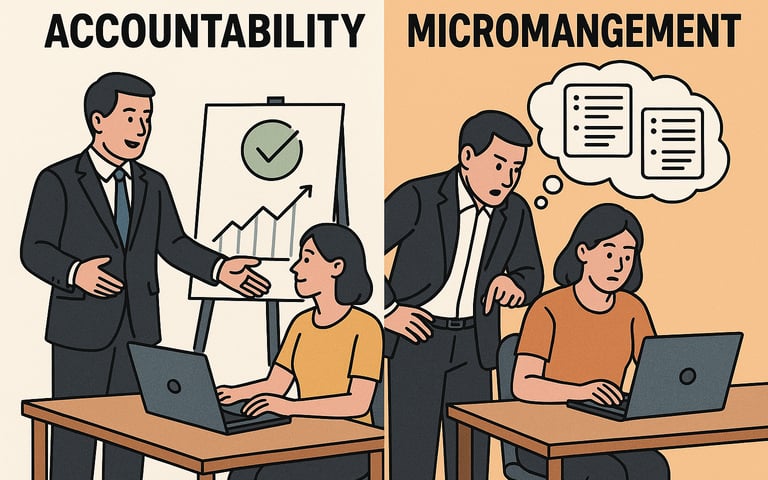
Micromanagement vs. Accountability
Many leaders defend micromanagement by calling it accountability. The two are not the same.
Accountability is about clarity of expectations and ownership of outcomes. Micromanagement is about controlling the path to get there.
Accountability says, “Here is what success looks like, and I trust you to deliver.”
Micromanagement says, “I will tell you how to deliver, step by step.”
Research from MIT Sloan shows that autonomy combined with clear goals produces higher performance than tight control paired with vague expectations.
Strong leaders manage outcomes. Weak leaders manage activity.
How to Recognize Micromanagement in Yourself
Micromanagement often hides behind good intentions. These signals are worth paying attention to.
If you frequently rewrite work instead of coaching.
If you check progress more often than necessary.
If you feel uneasy when decisions are made without you.
If you give instructions instead of outcomes.
If your team waits for approval on small decisions.
These are not signs of high standards. They are signs of low trust.
Recognizing this pattern is uncomfortable, but it is the first step toward change.
How Leaders Stop Micromanaging Without Losing Control
The solution to micromanagement is not disengagement. It is intentional leadership.
Start by clarifying outcomes instead of methods. Be explicit about what success looks like, the constraints that matter, and the checkpoints you expect. Then step back.
Shift your questions. Instead of asking, “Did you do it this way?” ask, “How are you approaching this?” Curiosity builds capability. Control suppresses it.
Reduce check-ins to agreed moments. Frequent interruptions signal distrust. Predictable rhythms signal confidence.
Coach instead of correct. When something is not right, resist the urge to fix it yourself. Ask what the person learned and what they would adjust next time.
Most importantly, examine the fear driving your behavior. Are you afraid of failure, judgment, or loss of relevance? Addressing that fear directly is more effective than managing around it.
These shifts align closely with the principles outlined in Leadership Foundations. Discipline, clarity, and accountability are what replace control when leaders mature.


When Micromanagement Feels Necessary
There are moments when closer oversight is appropriate. New hires. High-risk situations. Crisis moments. Even then, the goal is temporary guidance, not permanent control.
The difference lies in intent. Are you building capability, or are you compensating for your own anxiety?
Leadership in change and crisis often tempts leaders to tighten control. The strongest leaders resist that impulse by increasing clarity instead of control.ing.
Letting Go Is a Leadership Skill
Micromanagement feels productive in the short term. It creates the illusion of control. But over time, it weakens everything leadership is supposed to strengthen.
Trust.
Capability.
Ownership.
Judgment.
Leadership is not about hovering.
It is about creating space where others can perform.
If you want to build teams that think, act, and adapt without constant oversight, micromanagement must be confronted honestly. Not with guilt, but with discipline.
About Forge of Leadership
Forge of Leadership helps leaders replace control with clarity and fear with trust. We focus on practical leadership behaviors that build strong teams capable of performing without constant supervision.
Join Us
Get insights in the Forge community

The Forge Mission
Forge of Leadership shapes modern leaders through clarity, accountability and integrity, blending actionable systems with lessons, stories, and insights that inspire growth and sharpen purpose. Lead with intent!
© 2025. All rights reserved.