
When Good Leaders Burn Out Their Best People
Burnout isn’t always caused by bad leadership. This article explains how well-intentioned leaders overload high performers, why burnout shows up late, and how responsible leadership prevents it.
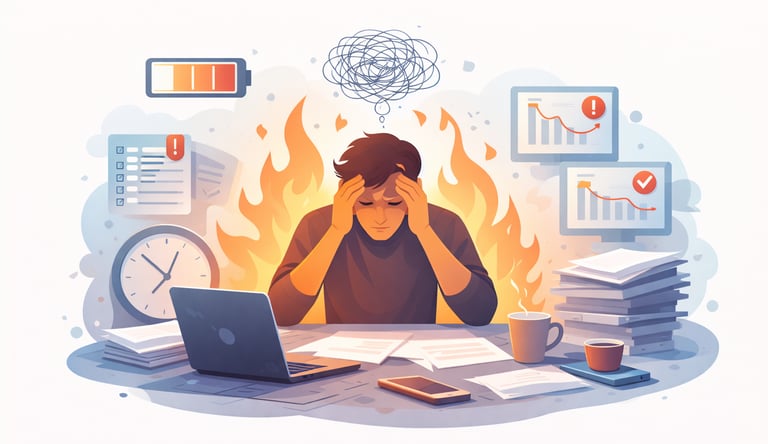

When Good Leaders Burn Out Their Best People
Burnout rarely starts where leaders expect it to.
It doesn’t begin with complaints or declining performance. It often begins with reliability. With the people who always deliver. The ones leaders trust instinctively because they remove friction instead of creating it.
Most leaders don’t burn out their best people through neglect.
They do it through trust.
This article explores a pattern many leaders miss until it’s too late: how good intent, high standards, and reliance on strong performers quietly combine into sustained overload.
The hidden pattern behind high-performer burnout
High performers burn out differently.
They don’t push back early. They adapt. They compensate. They absorb pressure because they are capable and because they care. Over time, dependability turns into default ownership.
Harvard Business Review has written directly about this dynamic in the context of leaders unintentionally overloading their top talent. The core point is uncomfortable but accurate: it’s easy to keep giving to the person who keeps saying yes.
What leaders mean as confidence often becomes accumulation.
One extra responsibility here. One urgent task there. One “you’re the safest pair of hands” decision after another. None of it looks unreasonable alone. Together, it becomes continuous strain with no natural release..
Why good intent becomes part of the problem
This pattern persists because it feels responsible.
Leaders allocate work where it will be done well. They rely on people who don’t need close supervision. They reward competence with autonomy. In a lot of leadership advice, this is framed as trust and empowerment.
The problem is that trust without recalibration becomes extraction.
High performers often stay silent until it’s too late, which overlaps with what you explored in Why Your Team Doesn’t Push Back Anymore. Silence isn’t always agreement. Sometimes it’s adaptation.
By the time leaders notice disengagement, the person is often already depleted.
Burnout is often a leadership visibility failure
Burnout is defined by the WHO as an occupational phenomenon resulting from chronic workplace stress that hasn’t been successfully managed. That definition matters because it shifts focus away from personality and toward conditions.
Leaders see outcomes. They don’t always see cost.
They see consistency. They don’t always see cognitive load.
They see delivery. They don’t always see what was sacrificed to make it happen.
Gallup’s research consistently highlights that burnout correlates strongly with how people are managed and supported, not simply with working hard. The leaders who miss burnout signals are often the leaders who believe they’re being fair because performance remains high.
This ties directly to your Muddy Boots Leadership piece. When leaders drift from the real work and rely on filtered updates, strain becomes invisible.


The uneven distribution of pressure
Pressure is rarely spread evenly across teams.
It flows toward the people who can handle it. Over time, those people become pressure sinks. Others are protected, consciously or not, because they are learning, more vocal, or less reliable.
Good leaders often justify this as temporary.
“It’s just this phase.”
“They’re strong.”
“I’ll rebalance later.”
Later rarely comes.
Instead, the strongest performers become the solution to every problem. Responsibility accumulates faster than recovery.
McKinsey’s work on burnout makes a similar point from an organizational angle: many companies focus on individual coping strategies while ignoring structural causes that create burnout in the first place.
The loyalty trap
High performers are often loyal beyond contract or role.
They identify with the mission. With the leader. With the team’s success. That loyalty delays warning signs. They endure longer than they should. They normalize strain.
When they finally speak up, the conversation is no longer about workload. It’s about exhaustion, disengagement, or the quiet decision to leave.
Leaders often feel blindsided. In reality, the signals were present, just muted.
This is the same silence pattern you explored in The Silent Meeting. When people stop challenging leaders openly, strain and disengagement often move underground first.
What responsible leaders do differently
Preventing this kind of burnout does not mean lowering standards or avoiding challenge. High performers want meaningful responsibility.
The difference lies in monitoring load, not just output.
A practical way to do this is to track what rarely shows up in performance metrics: who carries invisible coordination, who absorbs risk, who becomes the default escalation, who never says no, and who would struggle most if one more urgent task landed on their desk.
Those aren’t dashboard questions. They’re leadership attention questions.


The role of intentional rebalancing
Rebalancing work away from top performers is uncomfortable.
It feels inefficient in the short term. It introduces risk. It may slow delivery. But leadership is not about maximizing output this quarter. It is about sustaining capability over time.
McKinsey frames this in terms of solving root causes rather than symptoms, which includes redesigning work and management practices instead of only offering wellness interventions.
Sometimes the most responsible move is to accept temporary inefficiency so the team can build bench strength and your strongest people can recover.
Burnout is a lagging indicator
By the time burnout becomes visible, the damage is already done.
What leaders can influence lives earlier. The accumulation of small asks. The unspoken expectations. The habit of returning to the same people because it feels safe.
Burnout among high performers is rarely about weakness. It is about sustained pressure without recalibration.
Leaders who understand this don’t wait for collapse. They notice patterns early and intervene quietly.
Final Thought
Good leadership does not protect people from effort.
It protects them from being invisibly consumed by it.
The best people rarely ask for less. That makes them easy to overload and hard to read. Responsibility means noticing who keeps going long after they should have been asked to stop.
Burnout is not always a failure of resilience. Sometimes, it is a failure of leadership attention.
About Forge of Leadership
Forge of Leadership is a leadership blog built around one idea: leadership is forged under pressure, not learned through slogans. It focuses on practical judgment, clear standards, and the habits that build trust when responsibility becomes real.
Join Us
Get insights in the Forge community

The Forge Mission
Forge of Leadership shapes modern leaders through clarity, accountability and integrity, blending actionable systems with lessons, stories, and insights that inspire growth and sharpen purpose. Lead with intent!
© 2025. All rights reserved.