
Forge Reads: The Dichotomy of Leadership
A Forge Reads review of The Dichotomy of Leadership by Jocko Willink and Leif Babin. An honest look at leadership trade-offs, decision pressure, and why balance matters more than rules.
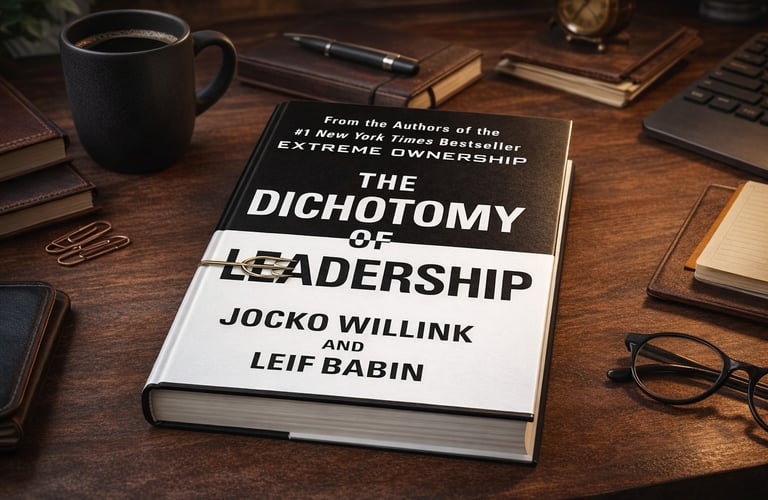
Forge Reads: The Dichotomy of Leadership
Leadership rarely fails because someone wanted the wrong thing.
More often, it fails because a leader pushed the right thing too far.
That is the quiet premise running through The Dichotomy of Leadership. It does not argue against strong leadership traits. It warns what happens when leaders stop adjusting those traits to reality. Confidence becomes arrogance. Empowerment turns into neglect. Control turns into suffocation.
This book is not trying to teach leadership principles. It assumes you already know them. What it challenges is how rigidly you apply them once pressure builds.
What This Book Is Actually About
At its core, The Dichotomy of Leadership is a book about judgment under tension.
Each chapter explores a leadership tension that looks simple on paper and becomes complicated in practice. When to stay close to the work and when to step back. When to push standards and when to absorb friction. When to trust your team and when to intervene.
What makes the book effective is that these tensions are not resolved with rules. They are shown through consequences. The authors consistently place themselves inside the failure, not above it.
This approach mirrors what research has long suggested. Harvard Business Review has repeatedly shown that leadership effectiveness declines when leaders apply “best practices” without adapting them to context. The book does not cite this explicitly, but it lives in the same truth.
Why This Book Matters More Once You Lead
Early leadership advice feels clean because consequences are limited. As responsibility grows, decisions stop being binary. Every choice creates a trade-off. Every strength has a shadow.
This is where The Dichotomy of Leadership becomes relevant.
It speaks to leaders who have already felt the cost of being decisive too fast, or patient too long. Leaders who have learned that clarity and discipline are not enough on their own. Leaders who recognize that leadership is not about consistency of behavior, but consistency of intent.
This ties directly to ideas explored in Leadership Foundations. Principles like clarity and discipline only work when leaders adjust their application to the situation. Without that adjustment, foundations become constraints.


The Value Is in the Friction
The book’s strength is restraint. It does not rush to conclusions. It stays in the discomfort long enough for insight to form.
You are shown how leaders lose teams by hovering too closely, a pattern explored further in The Micro-Manager Problem. You are also shown how leaders lose control by stepping back too far, something many well-meaning leaders experience when trying to empower others.
Rather than offering a solution, the book forces a question:
Where are you overcorrecting right now?
That question is more useful than any checklist.
How It Changed the Way I Think
This book did not give me new language for leadership. It changed how I listen to myself while leading.
It sharpened my awareness of moments where I lean too heavily on what once worked. Where intensity feels productive but reduces trust. Where stepping in feels helpful but removes ownership. Where staying calm crosses into avoidance.
That awareness is uncomfortable. It is also necessary.
McKinsey’s research on leadership effectiveness under pressure shows that leaders who fail to adjust behavior dynamically are more likely to degrade team performance during complexity and stress. The Dichotomy of Leadership puts that reality into lived experience.
Who This Book Is For
This is not a book for people looking for confidence.
It is a book for people already carrying responsibility.
If you are leading others and sensing that familiar advice no longer fits cleanly, this book will resonate. If you have felt the tension between trust and control, between urgency and patience, between direction and autonomy, it will feel uncomfortably accurate.
If you are early in leadership, it may feel abstract.
If you are further along, it will feel precise.
Final Thought
The Dichotomy of Leadership does not simplify leadership.
It complicates it in the right way.
It reminds you that leadership is not about choosing the correct principle and applying it harder. It is about noticing when a strength is becoming a liability and having the discipline to adjust before damage sets in.
That kind of leadership is quieter.
It is harder to explain.
And it lasts longer.
That is why this book belongs in Forge Reads.
About Forge Reads
Forge Reads is a curated collection within Forge of Leadership, focused on books that shape real leadership judgment under pressure. It highlights ideas that hold up once responsibility is real, not shortcuts or theory. Each entry reflects how a book influences decisions, behavior, and balance in practice.
Join Us
Get insights in the Forge community

The Forge Mission
Forge of Leadership shapes modern leaders through clarity, accountability and integrity, blending actionable systems with lessons, stories, and insights that inspire growth and sharpen purpose. Lead with intent!
© 2025. All rights reserved.