
When High Standards Turn Toxic
High standards are essential for leadership, but when applied without awareness they can create fear, silence, and burnout. This article explores where excellence turns toxic and how leaders prevent it.


When High Standards Turn Toxic
High standards are often praised as a leadership virtue.
They signal seriousness, ambition, and commitment to excellence. Many leaders build their identity around them. They push because they care. They demand because they believe in the mission. They hold the line because lowering it feels irresponsible.
And yet, some of the most damaging leadership environments are built by leaders with the best intentions.
This article explores where high standards stop strengthening teams and start constraining them. Not through abuse or ego, but through accumulation, silence, and misapplied discipline.
When Standards Stop Teaching and Start Pressuring
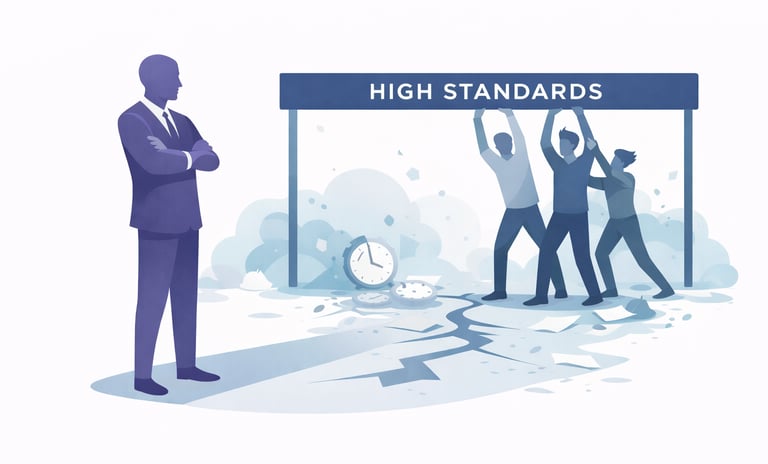
High standards become toxic not when they are explicit, but when they are unexamined.
Leaders set expectations. Over time, those expectations harden. What once required effort becomes baseline. What once earned recognition becomes assumed. Performance that used to be “strong” becomes “normal.”
Teams adjust quietly.
Harvard Business Review has shown that chronic high-pressure environments often develop not from aggressive leadership, but from persistent expectation escalation without recovery or recalibration.
From the leader’s perspective, standards never changed.
From the team’s perspective, the floor kept rising.
The Difference Between Discipline and Fear
Discipline creates clarity.
Fear creates compliance.
The two can look similar on the surface. Both produce results. Both suppress error. Both accelerate delivery in the short term.
The difference shows up over time.
In disciplined environments, people ask questions early. They surface risks. They challenge assumptions. In fear-driven environments, people wait. They comply. They avoid attention.
This dynamic connects directly to Why Your Team Doesn’t Push Back Anymore. When standards are enforced without space for challenge, silence becomes the safest response.
High standards don’t cause silence on their own. The absence of psychological margin doe
Good Leaders Rarely See the Damage Early
This is what makes toxic standards difficult to detect.
Output stays high. Deadlines are met. Metrics look good. The people under the most pressure are often the most reliable. They don’t complain. They adapt.
As explored in When Good Leaders Burn Out Their Best People, high performers absorb pressure differently. They interpret standards as personal responsibility. They internalize load instead of redistributing it.
Gallup’s research shows that burnout is strongly correlated with perceived fairness and manageability of expectations, not simply workload.
Leaders often miss this because nothing is visibly breaking. Until it does.


When Excellence Becomes Extraction
Standards turn toxic when they are enforced unevenly.
Pressure tends to concentrate around the most capable people. Others are shielded or given time to grow. Over time, the strongest performers become the system’s shock absorbers.
This is rarely intentional. It’s efficient. It feels responsible. It keeps things moving.
McKinsey has highlighted that organizations often confuse high performance with infinite capacity, leading to unsustainable talent models that rely too heavily on a small group of top contributors.
Standards, in this context, stop being about excellence. They become a mechanism for extraction.
How Leaders Reclaim Healthy Standards
Lowering standards is not the answer.
Healthy leadership preserves excellence while restoring margin.
Leaders who avoid toxic standards do a few things differently. They regularly reassess what “good” looks like as context changes. They separate stretch from sustain. They watch who consistently absorbs pressure and intervene before exhaustion appears.
This requires presence, not policy. As discussed in Muddy Boots Leadership, leaders who stay close to the work see strain before it becomes failure.
Standards should guide behavior, not consume people..
The Long-Term Cost of Ignoring This
Toxic standards rarely cause immediate collapse. They cause gradual erosion.
People stop volunteering ideas. They stop taking risks. They protect themselves. Over time, creativity narrows and trust thins.
The organization may still perform, but it becomes brittle.
By the time leaders notice disengagement, the problem is no longer about standards. It’s about recovery.
The role of intentional rebalancing
Rebalancing work away from top performers is uncomfortable.
It feels inefficient in the short term. It introduces risk. It may slow delivery. But leadership is not about maximizing output this quarter. It is about sustaining capability over time.
McKinsey frames this in terms of solving root causes rather than symptoms, which includes redesigning work and management practices instead of only offering wellness interventions.
Sometimes the most responsible move is to accept temporary inefficiency so the team can build bench strength and your strongest people can recover.
Final Thought
High standards are essential to leadership.
Unexamined standards are dangerous.
The difference is not intent. It is attention.
Leaders who hold the bar without watching the people beneath it eventually mistake endurance for alignment. Responsibility means knowing when standards are building strength and when they are quietly draining it.
Excellence should sharpen teams, not wear them down.
About Forge of Leadership
Forge of Leadership explores leadership where responsibility is real and pressure reveals truth. The focus is on clarity, discipline, and judgment built through presence, not abstraction.
Join Us
Get insights in the Forge community

The Forge Mission
Forge of Leadership shapes modern leaders through clarity, accountability and integrity, blending actionable systems with lessons, stories, and insights that inspire growth and sharpen purpose. Lead with intent!
© 2025. All rights reserved.